By Wienny N Laksmi · April 30, 2026
Methodology
Not all yoga is the same, even though it often looks similar from the outside. The Iyengar method, the approach every teacher at Yoga Omah Joglo is trained in, is built on a specific philosophy that sets it apart from more flow-based or fitness-oriented styles.
Who Was B.K.S. Iyengar?
Bellur Krishnamachar Sundararaja Iyengar, known as B.K.S. Iyengar, was born in 1918 in a small village in Karnataka, India, into a large, poor family. He was a sickly child: frequent illness as a boy left him physically weak, and by his teens he had a low life expectancy. At 15, he was sent to study under his brother-in-law, a yoga teacher in Mysore, largely as a way to improve his health. It worked. Yoga became not just a treatment, but his life's work.
By the 1950s, Iyengar had begun teaching abroad, including the celebrated violinist Yehudi Menuhin, who helped introduce him to audiences in Europe. His 1966 book, Light on Yoga, became one of the most widely translated yoga texts in the world and helped bring the practice to a Western audience that had mostly seen it as an obscure spiritual curiosity. In 1975, he founded the Ramamani Iyengar Memorial Yoga Institute in Pune, India, named after his late wife. By the time of his death in 2014, at age 95, his method was being taught at hundreds of centers worldwide, by thousands of certified teachers, to millions of students. His daughter Geeta and son Prashant continued his teaching legacy after him.
Iyengar's own life is, in many ways, the origin story for everything the method emphasizes today: a body that started out frail and misaligned, made strong and functional not through force, but through patient, precise, well-supported practice.
Not Acrobatics: What Beginners Should Actually Expect
A common misconception, especially for people whose only exposure to yoga is social media, is that a first class should look like the flexible, pretzel-like poses often shown online. That's not what Iyengar yoga is, and it's not what a first class at Yoga Omah Joglo looks like either.
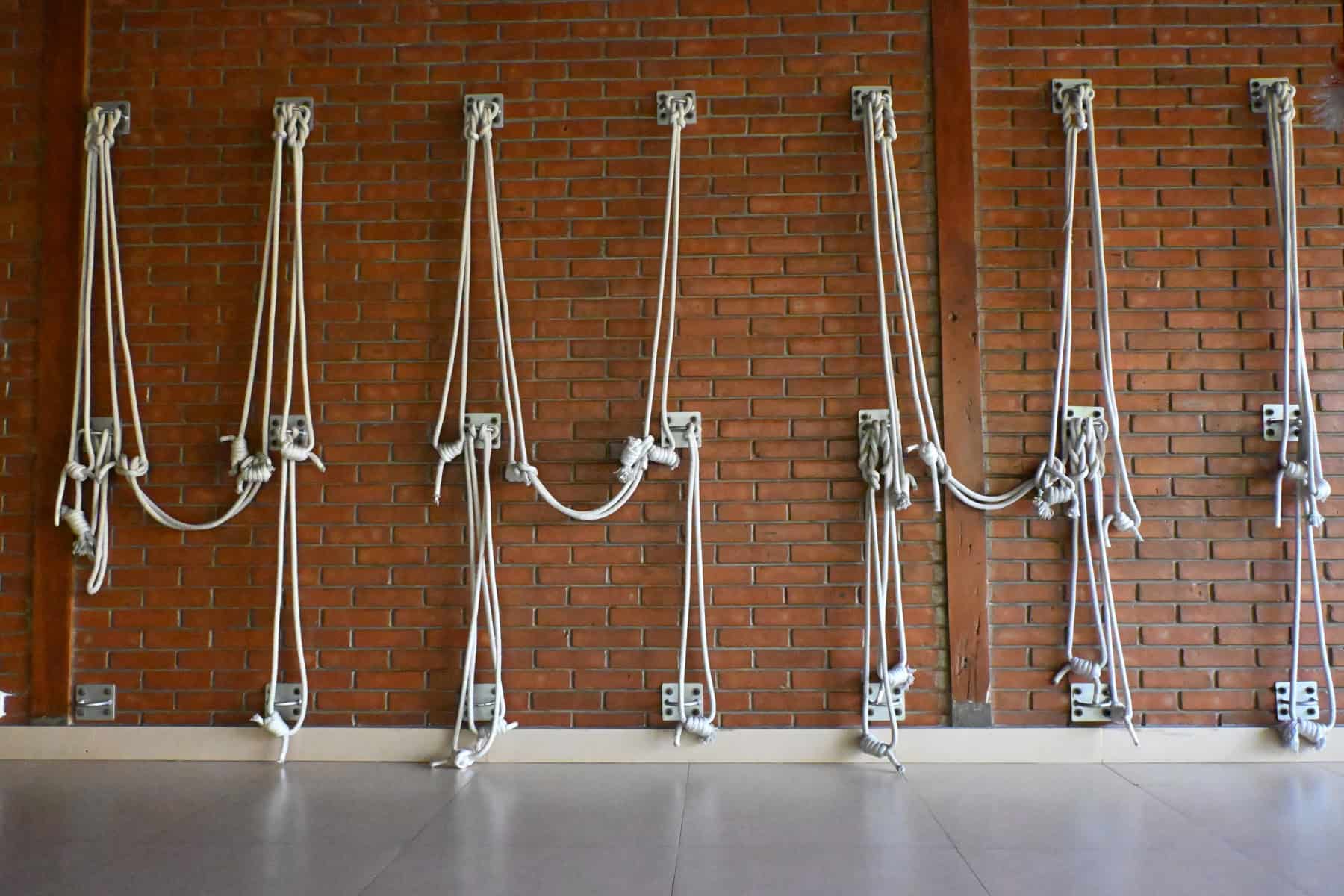
The method was built specifically to make yoga accessible to bodies that aren't naturally flexible, not to showcase ones that already are. Iyengar himself introduced props, blocks, straps, chairs, bolsters, precisely because most people, especially beginners, can't safely fold into advanced shapes without support. A beginner's first class typically involves basic standing postures, careful attention to how the feet and spine are positioned, and a teacher correcting small details most students wouldn't notice on their own. It's slower, more deliberate, and far less physically demanding than it may look from the outside.
Flexibility and advanced postures come later, and gradually, as a result of consistent, correct practice, not as a starting requirement.
Four Principles, Applied to Every Class
Alignment. Correct positioning of the body in each posture, not just approximating the shape, but understanding exactly how it should be held.
Precision. Deliberate, exact movement. A pose isn't just performed; it's refined, adjusted, and corrected in real time.
Awareness. Understanding what each part of the body is doing, and why, rather than following instructions passively.
Progressive development. Building safely from foundational postures toward more advanced ones, rather than rushing toward difficulty.
Why Props Matter
Props aren't beginner training wheels or a sign of limitation. They're tools that make correct alignment accessible to every body, regardless of flexibility, injury history, or age. This is part of why the method works well for therapeutic applications. A student recovering from an injury, managing a postural condition, or simply less flexible than average isn't excluded from a full pose; they're supported into a version of it that's still structurally correct.
Why Yoga Is a Practice, Not a Skill to Master
It's tempting to think of yoga the way you might think of a martial art: learn the moves, master the form, and eventually you're "done." That's not how yoga works. It's called a practice for a reason: something you return to again and again, not because you haven't learned it yet, but because the body, the breath, and the mind you bring to the mat are different every single time. A posture that felt effortless last week might feel entirely different today. The practice isn't a ladder you climb and then step off of. It's closer to a relationship you maintain.
This is also why experienced students and teachers, including B.K.S. Iyengar himself, continued practicing daily for decades, not because they hadn't yet "won," but because the practice itself was the point.
Simple-Looking Movements, Thousands of Combinations
To an outside observer, many yoga postures can look deceptively simple: stand here, bend there, hold this position. But a posture in the Iyengar method is rarely just one static shape. Foot placement, weight distribution, spinal rotation, shoulder position, breath timing, and dozens of smaller adjustments all interact with each other, and a small change in one element changes the effect of the entire posture.
Take something as ordinary as a forward stretch, the kind almost everyone has done at some point: bending forward to touch your toes. Most people approach this the way they were taught in school gym class: bend from the waist, reach down, maybe bounce a little to push further, hold your breath while straining toward your toes. It looks simple, and it's the same motion most people repeat for years without thinking twice about it.
In the Iyengar method, that same forward stretch is treated completely differently. Instead of bending from the waist, the movement starts by lengthening the spine first, extending upward before hinging forward from the hips, not the lower back, to avoid compressing the spine. The breath isn't held; you exhale slowly as you fold forward, using the exhale to soften into the stretch rather than forcing it. And the "push" isn't a bounce or a strain toward the toes at all; it's a controlled, incremental release, going only as far as the breath and the body allow that day, sometimes with a block placed under the hands so the spine doesn't round to compensate for tight hamstrings.
The shape looks almost identical to the version most people already know. The mechanics, the sequencing, and the intention behind it are entirely different, and that difference is exactly why the same "simple stretch" can either strain the lower back over time, or gradually build the flexibility and spinal health it was meant to.
Multiply that across dozens of foundational postures, each combined with different props, different modifications, and different sequencing depending on a student's body and goals, and the number of meaningful variations runs into the thousands.
Why a Teacher Is Not Optional
It might be tempting, especially for a student who's attended a few classes, to think they can now practice safely alone by memorizing a sequence. This is where a guiding teacher becomes essential, and not for business reasons.
Alignment errors are often invisible to the person making them. A slightly rotated knee, an unevenly weighted spine, a shoulder compensating for a tight hip: these are the kinds of small misalignments a practitioner usually can't feel or see in themselves, but a trained eye can spot immediately. Left uncorrected, they don't just reduce the benefit of the posture; over time, repeated incorrect alignment is how injuries actually happen, not from doing yoga, but from doing it slightly wrong, consistently, without anyone there to catch it.
A teacher's role is to see what the student can't see about their own body, and to adjust before a small imbalance becomes a real injury. This is especially true in Yoga Therapy, prenatal classes, and sessions for older students or those recovering from existing conditions, where the margin for error is smaller and the stakes of a mistake are higher.
Precision as a Foundation for Healing
This attention to detail is also why the Iyengar method lends itself naturally to Yoga Therapy: individualized sessions built around a student's specific condition, rather than a fixed class sequence. The same precision that refines a posture for an advanced practitioner is what allows a teacher to carefully adapt that same posture for someone managing chronic pain, limited mobility, or a structural imbalance.
Yoga Omah Joglo is an independent studio and is not an official Iyengar centre or affiliated institution. "Iyengar" refers to the teaching methodology our teachers are trained in.
Who It's For
Because of its emphasis on precision over pace, the Iyengar method tends to suit a wide range of students: complete beginners who want to learn correctly from the start, experienced practitioners looking to deepen their technique, and anyone recovering from injury or managing a physical condition that requires careful, guided movement.